


While I’ve attended a couple writing conferences, the Santa Barbara Writers Conference and the Community of Writers at Squaw Valley, my friend Christine over at 80,000 words is much more experienced in this department and has offered to write a guest post about writing residencies and conferences. Enjoy!
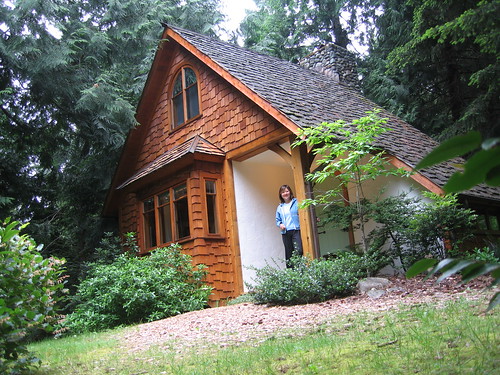
Finding space (psychic and physical) and time to write is half the battle of writing. Some of us are lucky enough to have room for an office inside our homes, and others find that home might be too cramped or holds too many distractions and find their way to a favorite cafe or pub. (For the record, I hold the dining room table hostage as my writing space).
Home, however, still has its pratfalls: you still get distracted, the phone still rings, other non-writers occupy the space and “remind” you of your other worldly obligations as a parent/spouse/housemate/normal-human-being-with-errands. And cafés have their drawbacks, too. So here is where writing residencies, aka “writing colonies,” come in.
A writing residency is a place that provides you with 24/7 focus on your writing, oftentimes providing you with prepared meals (with one meal, like dinner, eaten with other artists) and free room and board. It can be heaven for writers, with housing coming in the form of a room in a mansion, or darling little cottages, like at Hedgebrook.
It is *not* heaven if you do not go with a particular writing project in mind, or if you do not go with realistic expectations. (If you don’t normally write everyday at home, don’t expect to suddenly write everyday at the writing residency, for instance). So before applying, keep in mind what it is you wish to accomplish while at the residency—it is likely that this subject will have to be addressed in the application essay for residencies. Understand too, that a residency without a goal will not be a productive time.
Consider the geography—are you a city person? How will you fare in a writing residency in Maine with no running water in the cabin? If you’re a person used to being surrounded by people all the time, how will you fare at a writing residency like Soapstone, where you are on your own 24/7? Do you hate snow? Do you hate the heat? Consider all these factors as you apply to writing residencies, and their geography, and the season you select for residency.
And keep in mind the reference/recommendation letters; not all colonies require them, but many do—they want a third party opinion about your character, about your ability to stay sane and be productive at a writing residency, as well as get along with other writers. Many writing residencies require at least one reference letter. Give your recommender plenty of time to complete the reference letter, provide them with stamps, provide them with a copy of your statement of purpose (if it’s required), as well as the sample work you’re sending in along with your application.
Finally, what will you take with you once you get into a residency? (Congratulations!) Most residencies will give you a list of suggested items to bring … but it’s not unlike taking a vacation, because each of us has our own comfort levels whether “traveling light” or taking more than one backpack. Bring your favorite/useful books. If there is a particular food (like tea or coffee) that is part of your daily ritual, don’t expect the writing residency to carry it: bring your tin of Mariage Freres or Blue Bottle Coffee with you.
You may also want to bring a comfort item or two with you for those lonely moments when you miss home. Pack a DVD or two (or in my case, 12 DVDs because movies help me unwind). Bring comfy shoes—not only sneakers, but maybe some slip-ons if the writing residency doesn’t allow shoes indoors. Think about what it is you need to be comfortable. Of course: don’t forget your manuscript/laptop/writing tools.
The following are a few writing residencies in no particular order:
- Hedgebrook: a writing residency for women writers on Whidbey Island in Puget Sound adjacent to Seattle, Washington. Six amaaaaazing little post-and-beam cottages (see picture above) on a secluded, wooded parcel of land that resembles Narnia, and a more than wonderful staff.
- MacDowell: one of the best, most prestigious writing residencies in the nation, and thus one of the most competitive. The best writers, visual artists, and musicians convene to create, here. Friends who’ve gone to MacDowell either looooved it…or haaaaated their experience, there. I don’t think it’s for the lighthearted.
- Yaddo: another prestigious writing residency, ranked up alongside MacDowell. Artists all stay under one roof in the main mansion located in Saratoga Springs, New York. Like MacDowell people either loooooove their time at Yaddo or…don’t.
- Blue Mountain Center: very outdoorsy, beautiful. All my friends who’ve gone to Blue Mountain have loved it very much. They don’t allow cellphones (the reason I’ve never applied), and it is very rural.
- There are other writing residencies, like Jentel and UCROSS, both located in Wyoming…as well as Vermont Studio Center, Millay and VCCA, all highly regarded. I have only listed a few here, there are many many more writing residencies out there, including some abroad in beautiful European locations. For more writing residencies, check out this list or the Alliance of Artists’ Communities.
But what to do if you don’t just want to write, but to learn and convene with other writers? Writing is lonely. You want feedback, you want a sense of community; writing conferences address many of these needs.
Especially (but not only) if you haven’t the time or money to apply or enroll in an MFA program, writing conferences fill a big void for writers, providing workshops and mentors and community over a short period of time. I have met writers who’ve literally told me, “I go to writing conferences and workshop throughout the summer instead of getting an MFA”! Additionally, I’ve met a good number of MFA students who attend writing conferences to expand their writing network, find new mentors, and do extra workshopping at writing conferences.
Squaw Valley Writers’ Conference, Napa Valley Writers’ Conference,
- Attending Squaw Valley is like walking into an industry event. Squaw Valley Writers Conference is held at the Squaw Valley ski resort in the California Sierra Nevadas, which in the summer time is an idyllic high desert (read: warm, dry, high altitude) retreat. Attendees have the option of figuring out their own housing, but most opt to use housing arranged by the conference—which are single family homes in the area, within walking distance, and used as ski rentals in the wintertime. There are double rooms, triple rooms, and single rooms available—and many of the houses fit upwards of 10+ people, making for quite a party environment. Also, most of the houses have hot tubs…
- Napa Valley Writers’ Conference is more craft-centric than Squaw: you get assigned to one workshop—with one workshop leader. The summer I went, I studied with Aimee Bender, who was amazing and started each workshop morning with a bit of yoga (I kid you not). The conference is much quieter than Squaw or Breadloaf because of its focus on craft and less on shmoozing and because writers have to procure their own housing—while I was at Napa, I stayed at a small inn, which gave me less of a feeling of community but also gave me more downtown. (There’s something about having writers sleeping under the same roof at Squaw and Breadloaf…) The down to earth nature of Napa Valley Writers Conference has many advantages. This is also the conference where workshop leaders (who are Famous Writers) mingle among the writers with great ease. There is no head table at which Famous Writers sit, like at Breadloaf and Squaw, because they sit alongside everyone else at dinner. In fact, when I was at Napa, a charismatic man full of quips sat down next to me and started a conversation. The man was so
funny and quick, it was like sitting next to Stephen Colbert for dinner; I couldn’t get a word in edgewise, and all I did was giggle, like Junot Díaz on Stephen Colbert (until he finally got in a word in edgewise—the now infamous mention of tribbles). I didn’t know who he was, until later: Jim Shepard. Eeeeee! - VONA presents an amazing roster of instructors, all Famous Writers of color, there to mentor writers of color. It was life-changing for me as a writer, to study with Junot Díaz and Chris Abani, who are generous beyond words with their mentorship at VONA. There is a bit of “kumbaya” ceremony at the conference when it comes to honoring our heritage and ancestry (and I am quite allergic to such ritual), but totally bearable, and at moments I was quite touched by others’ passion. The workshops are second to none (and there is no chanting, kumbaya ancestor-worship inside of workshop, just at the opening and closing ceremonies of the conference).
- I’ve had friends attend Breadloaf; they earned waiterships and had the ironically prestigious position of being waiters at the writing conference (aka the lesser known term “work study scholar”). Waiters at Breadloaf are the darlings of the conference, given the competitive nature of procuring such a
scholarship, and so to me it’s no wonder they enjoyed the conference.
Breadloaf manages to attract a star-studded group of fantastic Famous Writer instructors each summer and I think it’s worth attendance for the opportunity to study with great writers. - Tin House Summer Writing Workshops is one of the newer writing conferences—and two of my friends have attended and loved their experience at Tin House. The instructors are all amazing and established writers. Unlike the other writing conferences listed, Tin House is neither in California nor the Northeast: it’s in Portland, Oregon.
The above are only a few writing conferences offered—but I listed the ones either I or my friends have attended. There are many more writing conferences out there. (You can search for more, here). If you haven’t yet applied for an MFA, this may give you a taste of the writing life, as it did for me when I attended Squaw. If you are getting your MFA or have already received your MFA, it is a great opportunity to get feedback from different voices, and to meet writers outside of your program.
Finally, I want to mention the annual AWP Conference. It is a mega-watt conference where writers and aspiring writers and professors convene—there are so many conference panels that it’s impossible to see/hear them all, and the pamphlet itself requires comprehensive perusal. I attended the one in New York City a couple years ago and it was amazing—I am pretty sure I was pooped out because I was still recovering from a health issue and couldn’t handle too much stimulation … but I’m also pretty sure it would have been overwhelming had I been in perfect health. The keynote speech by John Irving, one of my favorite living authors, changed the trajectory of my novel. There is no workshopping involved, no writing (unless you choose to do so in the comfort of your hotel room—but seriously, you’ll probably be pooped!), but there’s a ton of information being shared. For introverts like me, the social mixers will probably be frightening, but there are plenty of those, too.
Writing is lonely and arduous but also totally rewarding. It takes weeks and months to write a short story, let alone months and years to write a novel; in that amount of time, it is sometimes necessary to break out of our routine and seek out a writing colony or a conference where we can experience a change of scenery or bring different voices into our writing lives … and I hope this post helps you in that journey. 🙂
What about you? What experience have you had with writers’ conferences and residencies? Do you have a favorite?
Actually, I went to the Kenyon Review Writers Workshop, so it's not really a conference or a residency… but I loved it! Blogged about it a couple times, most recently: http://kristanhoffman.com/2009/12/06/ill-always-m…
KRWW is unique because it's all about the craft, not about networking. And you don't bring pieces to work on; you write completely new stuff while you're there. I totally get that that's not for everyone — heck, I was really doubtful it was even for me — but it turned out to be wonderful and I'm so, SO glad I did it. Now I'm a better writer, and I made a bunch of great friends and connections.
I've never attended any residencies or workshops like these, and have been thinking about it. This was really informative, thanks!
Kristan: I had heard of workshops where writers focus on creating new work–so I'm glad you chimed in here! I think there are tons of writers out there who do want a hybrid of the "writing colony" and "writing workshop/conference" experience; it definitely sounds interesting. How did they go about doing so?
Elizabeth: check them out–you know you can always email me offline for more info. 🙂
What a great, informative article! I have been playing with the idea of getting an MFA, but maybe I'll check out a conference before committing myself. Now then, off to the 7-11 for a lottery ticket…
Awesome article! I'm thinking of applying for Hedgebrook. I say that every year but I mean it this time. You've given me some great tips to consider, things I wouldn't have thought about, and the resources you've linked to weren't on my list. Thanks! 🙂
I've been to Santa Barbara and Squaw. SB was my first, so I was really excited to be there and I spent a lot of the time writing. I went to Squaw after completing my MFA and didn't learn much at all. I did make a lot of friends and a couple agent connections, but I was way too busy attending workshops to get any writing done. I love conferences because I get to spend a week surrounded by writers, but I think next time I'd rather do a residency and actually get some writing done.
[…] residencies and conferences Jump to Comments Check out my guest post on writing residencies and conferences over at […]
[…] about going to a writing conference or residency to work on your revisions? If so, read this guest post, by Christine Lee Zilka on […]
Thank you so much for posting this! I've been waffling back and forth for some time on whether to apply to a residency program or not and I'll likely blog about it. I run a writer's blog, Welcome to the Asylum. As the title obviously states, one of the goals in my career is to eventually provide a place for writers to physically take up residency. For now this is wishful thinking, but it won't always be…
A room of one's own??
[…] me with their comments and let me include them here. For more information about colonies, check out Christine Lee Zilka’s post, with helpful links, on Writerland and Allison Amend’s article on Yaddo for […]
[…] it’s writing colony season, might as well dredge up a guest post I wrote over at Writerland about various writing residencies and […]
I'm glad this post is helping all of you!
[…] If you need a longer list of the how/why behind residencies, check out a great blog post by fellow writer Meghan […]
Thanks for the post. I've been thinking about applying to Squaw Valley or Taos, possibly Tin House for the summer. I don't have an MFA, but have been flirting with the idea of getting one. Thank you for the informative post. Now to pick a program to apply to …
nice post! thanks for laying out all this information.
i recently blogged about artist / writers residencies i've experienced at Soapstone, Caldera, and Hypatia. if you're interested, it's here:
http://www.2gq.org/2010/03/writer-artist-residenc…
I'm so glad Christine offered to write this post, since it's been so useful for many of you.
Hanni – I've never been to Taos (for writing) or Tin House, but Squaw was great. Most people there didn't have MFAs, so you'll fit right in. And here's a post about my own MFA: http://bit.ly/cCy0Rw
Tiffany, I'll check out your link. Thanks!
Oh! I stayed in that very cottage in 1989! My experience at Hedgebrook — followed by the Bennington MFA Writing Seminars and fellowships at UCross and Vermont Studio Center — planted a dream seed that has just come to fruition. As the director of Beach Shack Writers' Residency on Hilton Head Island, I hope to recreate the same kind of wonderful experience that set me on my path.
Thanks for this great post!
You can view pictures and learn more about Beach Shack at http://www.beachshackwriters.com.
Cindy – that link is broken. But I looked at your FB page and that is no beach shack! It's stunning! Thanks for sharing the info.
[…] blogged a bit about writing conferences and residencies over at Writerland last year–and included VONA in my list of writing destinations. I don’t think I’d […]
Thanks for sharing you personal along with a glorious information Interesting site. I enjoy it Hello, Thanks for a fantastic post and interesting commentsassistance informatique really interesting topic, I’m very fortunate in order to come to your blog and i also will borkmark these pages in order that I really could keep coming back another time, if you learn ebook or manual reference ebook you can visit my blog at download free pdf ebook. baju muslim guzel paylasm tskler nice info on this site/article,thx for sharing. Btw i’m budisunardi im a web marketing i like to sell an asphalt sealing equipment by my website just check it out.
I've gone to three residencies. My first was Hedgebrook — one of the most rewarding and amazing experiences of my adult life! I went to Mesa Refuge, also fantastic, and then Norcroft, which, unfortunately closed a couple of years ago. All of them were fantastic, and after each residency I published a new piece of writing. Even though I didn't write every day at home, I did write every day and all day at the residencies. Hedgebrook was like a residency and a mini-mfa all rolled into one thanks to the wonderful combination of writers in attendance — we spent the days writing and the nights eating cookies and drinking wine and reading and discussing our work. Don't delay! Put in your application!
Natalie – You comment really makes me want to attend a residency! But with two small kids, I think it will be a few more years before I can get away for that long. Thank you so much for your feedback, on Hedgebrook in particular.
[…] that have already covered packing tips for writing residencies, most notably Nova Ren Suma’s, Christine Lee Zilka’s and and Christy Strick’s […]
[…] residency. This may not be as tempting as a sizable check, but professional writer and editor Meghan C. Ward notes a residency can be very beneficial to writers in the long term. A writing residency is a […]
kindly send out myself some techniques tips
I often use services of different writing companies. The last one was http://buy-an-essays.com/. Their writer completed a research paper for me. Nice job, I even didn’t expect that they would write a paper that brought me an A. Cool!
This type of post has been worthwhile in my opinion. We’ve just started out a self-hosted weblog web site this also post helped significantly. thank you!
[…] for more info on writing residencies, I came across a post at Meghan Ward’s blog over at Writerland that compares residencies in more detail. Share […]
All amazing guidelines. I’m book-marking this article, surely I am going to acquire writers block.
[…] I applied for a fellowship at the prestigious MacDowell Colony. The application ($30) was easy. The rejection I just received was less so. Here’s a list of writing residencies. […]
Numerous thanks! I merely added your weblog for the blogroll. Meow!
I guess I should fill something out even though I am here visiting. Many thanks for putting up excellent stuff. It’s asking for your website internet site here though I’m posting this, so here’s one which I had been just checking out. Choose treatment.
Really good blog you have here. You’ll discover me going through your stuff often. Saved as a favorite!
Hello, you used to write magnificent, but the last several posts have been kinda boring… I miss your super writings. Past several posts are just a little bit out of track! come on!
Happy writing!
This article presents clear idea in support of the new people of blogging, that actually how to do running a blog.
You really make it seem so easy with your presentation however I in finding this matter to be really something that I think I might by no means understand. It kind of feels too complex and very wide for me. I am looking forward for your subsequent submit, I’ll attempt to get the hold of it!
I’m writing to make you be aware of what a wonderful encounter my cousin’s child gained viewing your web page. She realized some details, most notably what it is like to possess an amazing giving spirit to have others very easily learn selected hard to do subject areas. You actually did more than my expectations. Many thanks for delivering those useful, healthy, edifying and even cool thoughts on this topic to Tanya.
Incredibly great web site thanks so much for your time in writing the posts for all of us to learn about.
I loved as much as you’ll receive carried out right here. The sketch is tasteful, your authored subject matter stylish. nonetheless, you command get bought an shakiness over that you wish be delivering the following. unwell unquestionably come more formerly again as exactly the same nearly a lot often inside case you shield this increase.
Hey! Quick question that’s completely off topic. Do you know how to make your site mobile friendly? My blog looks weird when viewing from my apple iphone. I’m trying to find a theme or plugin that might be able to resolve this problem. If you have any recommendations, please share. With thanks!
I enjoy what you guys are usually up too. This kind of clever work and reporting! Keep up the wonderful works guys I’ve added you guys to our blogroll.
Oh my goodness! an amazing article dude. Thanks However I’m experiencing concern with ur rss . Don�t know why Unable to subscribe to it. Is there anybody getting similar rss problem? Anybody who is aware of kindly respond. Thnkx
This website online is really a walk-via for all of the info you wanted about this and didn�t know who to ask. Glimpse here, and you�ll definitely discover it.
I’m really loving the theme/design of your web site. Do you ever run into any web browser compatibility problems? A number of my blog visitors have complained about my blog not operating correctly in Explorer but looks great in Safari. Do you have any advice to help fix this problem?
An interesting discussion is worth comment. I think that you should write more on this topic
I just could not leave your web site before suggesting that I really loved the standard info a person provide in your guests? Is gonna be again frequently in order to check up on new posts
An attention-grabbing discussion is price comment. I believe that it’s best to write more on this subject, it may not be a taboo subject but typically persons are not enough to speak on such topics. To the next. Cheers
Can I just say what a relief to find someone who really is aware of what theyre speaking about on the internet. You definitely know find out how to convey a problem to mild and make it important. More folks need to learn this and understand this facet of the story. I cant imagine youre not more in style because you positively have the gift.
Excellent post. I was checking constantly this blog and I am impressed! Extremely helpful information particularly the last part 🙂 I care for such info a lot. I was seeking this certain information for a long time. Thank you and good luck.
dress shops that offer discounts are very widespread in our location and i always shop at them’
When I initially commented I clicked the -Notify me when new feedback are added- checkbox and now every time a remark is added I get 4 emails with the identical comment. Is there any approach you’ll be able to take away me from that service? Thanks!
Wow that was remarkable. I immediately wrote an enormously prolonged observe nevertheless behind I clicked submit my observe didn’t confirm up. Grrrr… satisfactorily I’m not prose all that ended once more. In any case, a minute ago hunted to articulate admirable blog!
I really like and appreciate your blog post. Much obliged.
certainly like your web site but you need to check the spelling on several of your posts. Several of them are rife with spelling problems and I in finding it very troublesome to inform the reality on the other hand I¡¦ll surely come again again.
It¡¦s actually a cool and helpful piece of information. I¡¦m satisfied that you simply shared this helpful info with us. Please keep us up to date like this. Thanks for sharing.
Excellent goods from you, man. I have understand your stuff previous to and you’re just too great. I actually like what you have acquired here, certainly like what you are saying and the way in which you say it. You make it entertaining and you still care for to keep it smart. I cant wait to read much more from you. This is really a great web site.
I do agree with all of the ideas you have introduced for your post. They are very convincing and can definitely work. Nonetheless, the posts are very quick for beginners. May you please lengthen them a bit from next time? Thank you for the post.
Properly I seriously enjoyed reading it. This tip provided by you is extremely constructive for accurate planning.
Its like you read my mind! You appear to know a lot about this, like you wrote the book in it or something. I think that you can do with a few pics to drive the message home a little bit, but other than that, this is wonderful blog. A great read. I’ll definitely be back.
If you are searching for T-Shirt Printing Sydney then please click my website to find out more information! Thanks! 😀 If you like you can put a comment on my blog.
I have read so many articles or reviews on the topic of the blogger lovers except this post is in fact a pleasant paragraph, keep it up.
You made a few nice points there. I did a search on the theme and found most people will consent with your blog.
.House in the Woods can best be described as a combination of many types of architecture and credit for the originality of design …
.o many Georgians, home is the place where they come from, the place where the famiy line can be traced from memories and keepasakes. ..
One more issue is really that video gaming has become one of the all-time largest forms of entertainment for people of nearly every age. Kids engage in video games, and also adults do, too. Your XBox 360 is just about the favorite video games systems for many who love to have a lot of activities available to them, along with who like to experiment with live with other folks all over the world. Many thanks for sharing your opinions.
I was just looking for this information for a while. After 6 hours of continuous Googleing, at last I got it in your site. I wonder what is the lack of Google strategy that do not rank this kind of informative sites in top of the list. Usually the top web sites are full of garbage.
The crux of your writing while sounding reasonable originally, did not work well with me after some time. Somewhere throughout the paragraphs you managed to make me a believer unfortunately just for a while. I still have got a problem with your leaps in assumptions and one would do well to fill in all those gaps. When you actually can accomplish that, I could definitely be amazed.
YouTube includes not just comical and humorous videos but also it carries learning related video tutorials.
You got a very excellent website, Sword lily I noticed it through yahoo.
I guess your article is pretty fantastic. If u want to meet other people you also can check blog. I wanna thanks for that.
whoah this weblog is wonderful i love reading your posts. Stay up the good paintings! You understand, a lot of people are looking round for this information, you could aid them greatly.
Hi! Would you mind if I share your blog with my myspace
group? There's a lot of people that I think would really enjoy your content.
Please let me know. Cheers
Such precision in your work. Can’t imagine the time involved in going from start to completion. Thanks for the post
Thank you so much for sharing such a helpful post with us! All the safety measures are practical and life-saving aspect is very obvious in them.
I never read whole posts but the way you done this information is simply excellent also informative and this kept my interest in reading and I am happy for it. Thank you so much. This article has helped me to have another project. This article truly made my day. Thanks again.
My Friends all the time say that I am wasting my time here at web, however I know I am getting know-how every day by reading such pleasant posts.
Excellent post. I used to be checking regularly the following blog page with this particular motivated! Extremely helpful information and facts precisely the very last point 🙂 My partner and i care for these information a great deal. I’m trying to find this type of facts for a extremely extended period. Appreciate it and also of luck.
Very nice blog to read and to get inform i like it very much and impressed from it you know that you are so beautiful about your work so keep it up.
I would like to thanks for the efforts you’ve put in writing this blog. I’m hoping the same high-grade web site post from you in the upcoming also.
It's actually a cool and helpful piece of information. I am pleased that you just shared this valuable details with us. Please keep us up to date like this. Thanks for sharing.
I appreciate your blog as well as the sharing.
We weblog frequently we seriously many thanks for your posts. This information has actually actually peaked my personal attention. I am going to save your blog site and verifying for brand new details about once every seven days. I actually signed up for your current Feed at the same time.
I get a lot of great information here and this is what I am searching for.
This is a great blog posting and very useful. I really appreciate the research you put into it…Thanks..
This is an AMAZING post – I love the A-z Aspect of it. The mind is SO powerful, and so many people fail to see this or even take full advantage of it!
wish to glimpse more on this topic here. Thanks for posting this information at this present time.
That is a charming cottage! Is that the place where you stayed during conferences? 🙂
Philippine real estate | AyalaLandPremier
โปรสชาติมาร์ทโฟน เน็ตมิควบคุม 199 บาทา/ดวงจันทร์
(212.93 บ. จับกลุ่ม VAT)
เล่นเน็ตไม่ขีดคั่น
ใช้เรื่องตื๋อ 3G ได้รับ 500 MB
โทรให้เปล่าทั่วโครงข่าย 100 นาที
รับสิทธิ์เปลือง 3G กระแสความฉับพลันสุดยอดแม้ 42 Mbps
หลังเต็มส่วนแบ่งระวางลิขิต เฉลี่ยหดกระแสความไวเปล่าพ้น 128
Kbps
คิดค่านายหน้าพร้อมด้วยสร้างชนมพรรษาอัตโนมัติ
ผอมโซเชียลมิเล็ก + Internet 250 MB 199 บาท/รัชนี
(212.93 บมันสมอง ประสม VAT)
เล่นเน็ตได้มา 250 MB
เล่น Facebook, Line, WhatsApp การตั้งกฎเกณฑ์มิแคบ ทั้งดวงเดือน
คิดค่าบริการพร้อมทั้งดามปูนอัตโนมัติ
อ่านเก่านะจ๋า
ยังมีชีวิตอยู่การแยกส่วนด้วยกันอุปมาราคาเน็ตสัตแทค 199 พระบาท รายรัชนี ด้วยว่าผู้พื้นที่พึงประสงค์เปลืองเน็ตสนนราคาเขียม
199 บาท ดามศศิ
เนื่องด้วยงานลงสมัครเน็ตสะอาดแทค หรือว่าโปรเน็ตเป็นผลดีแทคอื่นๆ ทำได้พิจารณาหาได้แหล่งน้ำหน้าขั้นแรก โปรน่าพอใจแทค
โปรดีเลิศแทค 2 likes ไม่.ยมันสมอง 27, 2014 Share
Read more
It’s a pity you don’t have a donate button! I’d without a doubt donate
to this superb blog! I suppose for now i’ll settle for bookmarking and adding your RSS feed to my
Google account. I look forward to brand new updates and will share this website with my Facebook group.
Chat soon!
Not only does the app just fade out when the timer is
up, the sounds start to slow down so you should be completely relaxed and get a
great night’s sleep. Many parents would love to tuck their baby into a protective bubble that
prevents anything toxic from ever getting anywhere near.
When the baby wakes and cries for feeding or
nappy changing do it quietly and without fuss.
Hi there to every body, it’s my first pay a visit of this webpage;
this website contains amazing and genuinely fine material in support of readers.
If some one desires to be updated with hottest technologies after that he must be go
to see this web page and be up to date every day.
First off I would like to say terrific blog! I had a quick question in which I’d like to ask if you do not mind.
I was interested to know how you center yourself and clear your mind prior to
writing. I’ve had a hard time clearing my mind in getting my thoughts
out. I do take pleasure in writing however it just seems like the first 10 to 15 minutes are lost simply just trying to figure out how
to begin. Any ideas or tips? Many thanks!
After looking at a few of the blog articles on your web site,
I seriously appreciate your technique of writing a blog.
I bookmarked it to my bookmark website list and will be checking back soon.
Please visit my web site as well and tell me your opinion.
It’s in reality a nice and helpful piece of information. I’m happy that you simply
shared this useful information with us. Please
keep us up to date like this. Thanks for sharing.
my web-site custom home decor (Shani)
Both of our youngsters, Arek (age 9) and Talar
(age 11) appreciate their violin lessons with Bonnie.
As a collector of inspirational prices, I prefer to routinely submit several of the finest inspirational quotes I’ve encounter.
By “best” after all those that concisely catch what appears to
be for truly being happier some profound awareness. Guidelines 25.
And make sure to get all 201 greatest prices inside the free book above!
You need targeted visitors for your Writing residencies and conferences « WriterlandWriterland website so why not get some for free? There is a VERY POWERFUL and POPULAR company out there who now lets you try their traffic service for 7 days free of charge. I am so glad they opened their traffic system back up to the public! Sign up before it is too late: http://stud-project.url.ph/b
Thanks for the post. some useful stuff
Find new online money making website(s), where you can get secret strategies, and Free offers. Check it out, and decide for yourself if it’s right for you. For Free, No Obligation info, Visit the website at: http://onlinemoney.ADULTTHE.COM
Also there are apps that are a must as they help in the overall functionality of the iPhone.
The one linked underneath, although there are numerous sources.
I believe many of my “troubles” are like that.
Your made work purpose behind control is amazingly appreciative. You have indicated about it in clear way. residency letter of recommendation
Frightfully bad article. Waiting for some interesting material.